
Peyronies Disease

Peyronies Disease - 1

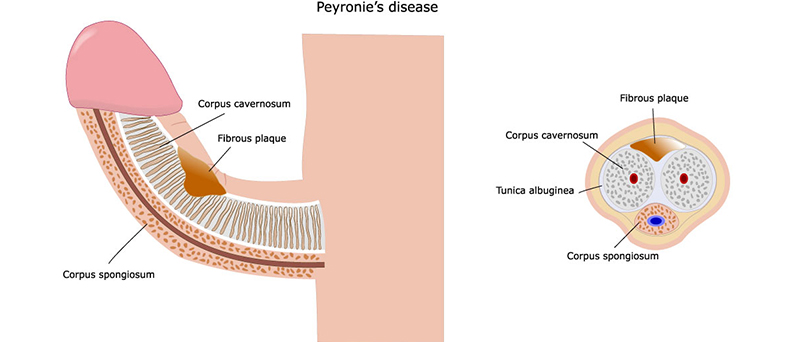
Peyronies disease is a common collagen-related disorder that affects 6-8 % of males over their lifetime. The primary protein that’s present in the tough lining of the penis is elastin, which means it’s able to stretch during an erection. Due to an abnormal inflammatory reaction, to which white men are genetically predisposed, excessive collagen (scar tissue) is deposited within the tunica albuginea of the corpse cavernosum.

As this collagen contracts over time due to myofibroblasts within the scar tissue, it results in penile curvature. The penis can curve in any direction. However, the most common is dorsally towards the patient. Once the dorsal curve extends beyond 40—45 degrees, penetration becomes difficult. Ventral curvatures are more poorly tolerated.

There is generally thought to be an inciting event that causes a bleed in the tunica albuginea of the corpus cavernosum, which starts an inflammatory process.
During this inflammatory phase, the penile plaque may become tender and is followed by progressive curvature as the plaque matures and the scarring contracts. Peyronies disease is also associated with erectile dysfunction, which is why Dr Campbell creates tailored treatment plans that manage both conditions.

Avoiding erections and intercourse will, unfortunately, not halt the progression of the plaque. Significant loss of length is often a consequence of the plaque and subsequent erectile dysfunction
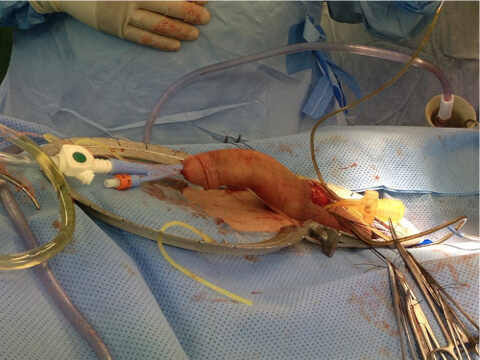
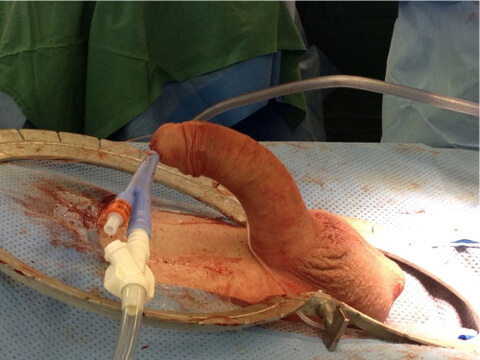
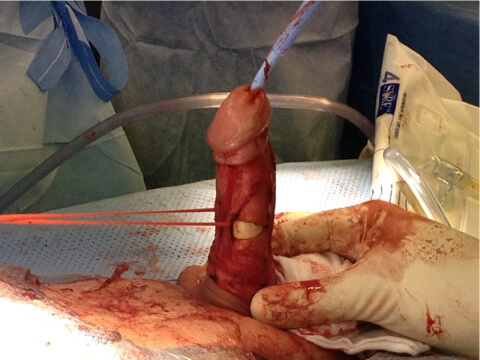
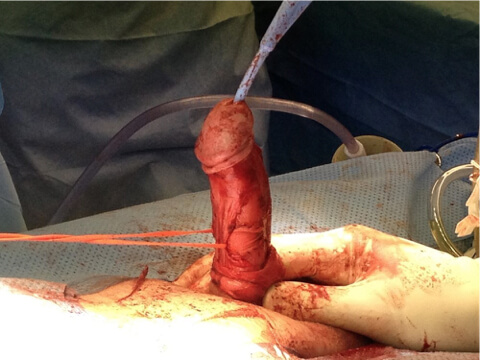
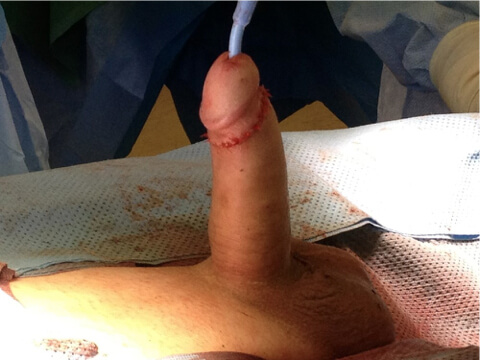
Penile surgery 05, Dr Campbell Gold Coast
Penile surgery 04, Dr Campbell Gold Coast
Penile surgery 03, Dr Campbell Gold Coast
Penile surgery 02, Dr Campbell Gold Coast
Penile surgery 01, Dr Alistair Campbell Gold Coast
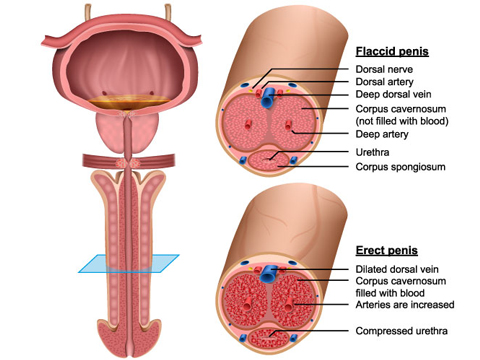
Peyronie's disease illustration 06, ED Clinic

Peyronies Disease: FAQs

Are there any non-surgical treatment options available?

Unfortunately, there are no effective topical or oral therapies that have been proven to stop plaque progression. Many of the patients that consult with Dr Campbell at his Gold Coast clinic have tried to use contraptions and weights to reverse the curvature but this is hardly ever effective because it requires several hours of use every day.

There is, however, a new medication called Xialflex, which helps break up the collagen in the penis, which allows it to straighten. There is a chance that the penis won’t become completely straight though. The primary aim is to correct the curvature to allow for easier penetration. The early results of this treatment have been very pleasing. However, being a new medication, it is expensive and patients may require up to 8 treatments. Patients have the option to stop treatment at any point if the curvature has been corrected to an acceptable point.

This is an outpatient treatment where a penile block is applied to make the penis numb, after which the medication is injected into the plaque. In essence, the medication is meant to act as a medical scalpel that cuts the plaque.

What type of surgery is required for Peyronies Disease?

The type of surgery that will be required is dependent on the state of the curvature.

Conservative
If the curvature doesn’t preclude penetration and the penis is suitably rigid for penetration, no treatment is required.

Nesbitts plication
This is where the tunica albuginea of the corpse cavernosum is plicated opposite to the side of the curvature to straighten the penis. The penis is therefore shortened further and there is a 5% risk that erectile problems will worsen.

Lue procedure
During this procedure, the penile plaque is incised or excised and grafted. In some cases, the length can be improved. However, the procedure can cause erectile dysfunction in 25-30% of patients, therefore is rarely done unless it’s performed in conjunction with a penile prosthesis

Penile prosthesis with or without grafting ( Lue ) procedure
A penile implant is also able to resolve erectile dysfunction and the cylinder pressure of the implant can largely resolve the curvature, which means a tunical graft will not be required. If significant curvature is still present after the implant is inserted, a graft can be performed with some improvement in length. This is a good option to resolve both erectile dysfunction and excessive curvature.

Peyronie's disease illustration 07, ED Clinic

CONTACT US

Our wonderful team is standing by ready to answer any questions you have

  • This field is for validation purposes and should be left unchanged.